

Businesses are continuously looking for new solutions to stay ahead of the competition in an ever-changing technological world. API integration is one solution that has transformed how organisations collect, exchange and use data across different software applications.
As we enter 2024, the importance of using API integration for predictive analytics has never been greater. Businesses need accurate and relevant information to understand changing customer behaviour, identify operational challenges and prepare for future demand. When data remains separated across different applications, however, producing timely and dependable forecasts can become difficult.
Predictive analytics uses historical data and mathematical models to forecast future events. This means that businesses can use the information they already hold to identify patterns and estimate what may happen next. These forecasts can support decisions involving inventory, customer service, sales, marketing and other important business activities.
This guide explains how API integration and predictive analytics work together to support business forecasting. It also explores the benefits businesses may gain by combining these technologies. Finally, it explains how to implement, monitor and assess an API integration solution.
Table of Contents
- API Integration Explained
- How APIs and Predictive Analytics Work Together
- Benefits of Combining APIs with Predictive Analytics
- Improved Productivity
- More Valuable Information
- Implement Your API Solution
- Monitor and Assess Your Solution
- Conclusion
- Frequently Asked Questions
API Integration Explained
An API, or application programming interface, is a collection of rules that determines how one software application communicates with another. It allows an application to request information or functionality from another authorised system.
When two software programmes are connected through an API, they can exchange data without requiring a user to enter the same information manually into both systems. This exchange may occur in real time, near real time or according to a scheduled process.
An API solution provides a practical mechanism through which different software programmes can exchange information. It creates a connection between applications that may otherwise operate separately.
For example, imagine that you own an e-commerce business that sends orders through a third-party fulfilment centre. Your online shop receives customer orders, while the fulfilment centre manages packaging and delivery.
Without an API connection, an employee may need to copy each order from the e-commerce system and enter it into the fulfilment centre’s system. This process requires additional time and may increase the possibility of human error.
With API integration, the order management system can exchange information directly with the fulfilment centre’s system. When a customer places an order on your website, the order details can be delivered automatically to the fulfilment centre. Its staff can then begin preparing the customer’s package.
The API acts as a controlled link between the two applications. It passes approved information from one system to another according to the rules established by the integration.
This example demonstrates why APIs have become important for businesses that use multiple applications. Instead of allowing every platform to operate in isolation, API integration helps businesses create a more connected digital environment.
The information exchanged through an API may include customer details, product information, order numbers, payment statuses or stock levels. The exact information depends on the applications, integration settings and business requirements.
Businesses must also consider how frequently their information needs to be updated. Some processes require immediate data exchange, while others may operate effectively with scheduled updates. The appropriate approach depends on how quickly the business needs to use the information.
How APIs and Predictive Analytics Work Together

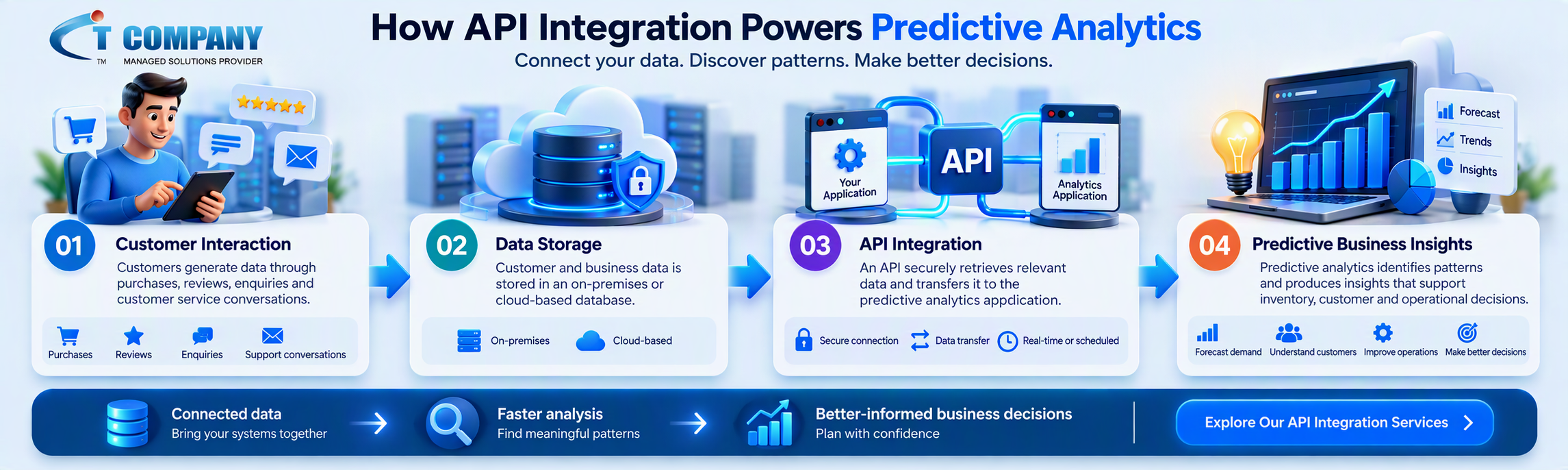
How do APIs and predictive analytics work together? The process begins when normal business activity produces information.
A customer may place an order, leave a review, contact a support team or interact with a business website. Each action creates data that may help the business understand customer needs, operational performance and future demand.
An API can make this information available to a predictive analytics application. The application can then examine the available data and identify patterns that may support future business decisions.
The relationship between APIs and predictive analytics can be explained through the following four steps.
Step 1: Customers Interact with a Business and Generate Data
When a customer interacts with a business, data is created. This information may take the form of a purchase, review, customer service conversation, product enquiry or website interaction.
Each individual activity provides only a small amount of information. When many activities are collected over time, however, they can reveal useful patterns.
For example, a retailer may notice that customers purchase certain products more frequently during a particular season. A service company may discover that customers commonly request support after using a specific feature.
The value of this information depends on whether the business can collect, organise and analyse it effectively. If data remains spread across several disconnected applications, creating a complete picture can be challenging.
Step 2: The Data Is Stored in a Database
The information generated through customer interactions is stored in a database. The database may be located on the company’s premises or hosted through a cloud-based service.
Storing the information is an important step, but stored data creates limited value if the business cannot use it. Employees need an efficient and secure way to retrieve relevant information for analysis.
A business may have several databases connected to different applications. Customer information may be stored in a customer relationship management system, while order information may be located in an e-commerce platform.
When the information is separated, analysts may spend considerable time collecting and combining records before completing any analysis. API integration can reduce this manual effort by creating a structured connection between the database and the application that needs the information.
Step 3: An API Retrieves Data from the Database
An API is used to retrieve authorised data from a database. It serves as a link between the database and the application that needs to access the information.
In this situation, the receiving application may be a predictive analytics tool. The tool analyses the information and uses appropriate models to estimate possible future events.
The API does not create the prediction by itself. Its role is to make the required information available to the analytics application in a consistent and efficient way.
For example, an analytics tool may need access to historical sales, product information and inventory levels. An API can retrieve these records and provide them to the tool without requiring an employee to export every data set manually.
The quality of the prediction still depends on the quality of the information supplied. Incomplete, duplicated or outdated data may affect the usefulness of the results. Businesses should therefore check their data before relying on a predictive model.
Step 4: The Insights Support Better Business Decisions
The insights gained from the data can then be used to improve business decisions. A retailer, for example, may use predictive analytics to estimate demand for a particular product.
The forecast may help the retailer determine how much stock to order. If stronger demand is expected, the business can prepare by increasing its inventory. If lower demand is predicted, it may avoid purchasing more stock than it is likely to sell.
Predictive insights may also support marketing, customer service and operational planning. A business might identify customers who may stop purchasing, anticipate periods of higher service demand or find products that are likely to become more popular.
These predictions should support informed judgement rather than replace it entirely. Business leaders should consider the forecast together with current market conditions, organisational objectives and their knowledge of customers.
Benefits of Combining APIs with Predictive Analytics
Combining APIs with predictive analytics can improve the way businesses collect information and make decisions. APIs help transfer relevant data, while predictive analytics uses that information to identify patterns and possible outcomes.
Each technology performs a different function. API integration connects applications and allows them to exchange data, while predictive analytics turns relevant information into forecasts or insights.
When the technologies work together, businesses can create a more efficient process. Information can move from operational applications to analytics tools without repeated manual data entry.
The resulting insights can also be returned to applications used by employees. For example, a customer risk indicator may appear in a customer management system, allowing an employee to review the account and decide whether action is appropriate.
Improved Productivity
Businesses can save time by retrieving information from a database through an API rather than entering it manually. Employees can focus on reviewing information and acting on insights instead of repeatedly transferring records between systems.
Manual data entry may also create inconsistencies. An employee may type an incorrect number, select the wrong customer or omit an important field.
API integration can make the transfer process more consistent by following the same established rules for each request. When properly configured, the connection can retrieve information in the required format and deliver it to the correct application.
Predictive analytics can also improve the speed of certain business decisions. Instead of waiting for an employee to examine every record manually, the analytics tool can analyse a larger volume of information and identify relevant patterns.
A retailer may use these patterns to prepare for changes in product demand. A service provider may use them to anticipate an increase in customer enquiries. A subscription-based business may use them to identify accounts that require attention.
Faster access to information does not mean that every decision should be automatic. Businesses should establish clear processes for reviewing predictions and deciding how employees should respond.
The main productivity benefit comes from reducing repetitive work and making relevant insights easier to access. This allows employees to spend more time on decisions and activities that require human knowledge.
More Valuable Information
Using an API in combination with predictive analytics can produce insights that may not be available from either technology alone. An API supplies information, while predictive analytics examines that information to identify patterns and estimate future outcomes.
For example, a company may use predictive analytics to identify customers who are likely to leave. The model may consider purchase frequency, account activity, customer service history or other relevant information.
If the data used to build or run the model is out of date, the results may be inaccurate. A customer could appear inactive even though that person completed a purchase recently through another application.
Businesses that use an API to retrieve current information from a database can help ensure that their predictive analytics models receive relevant data. This can improve the usefulness of the resulting insights.
Real-time information is not essential for every application. Some businesses may only need daily, weekly or monthly updates. The appropriate schedule depends on the decision being made and the speed at which the underlying information changes.
The business must also make sure that the data means the same thing across each connected application. One system may use a customer’s email address as an identifier, while another may assign an account number.
These differences should be addressed when the API solution is planned. Clear data definitions help the predictive analytics tool interpret the information correctly.
More current information can support better forecasting, but current data is not automatically accurate data. Businesses should continue to check for incomplete fields, duplicated records and unusual values.
Implement Your API Solution
Once you have planned your solution, it is time to put it into action. This involves setting up the appropriate infrastructure and connecting the selected applications through their APIs.
Before building the integration, identify the business decision that the solution needs to support. A clearly defined objective makes it easier to determine which applications, records and predictive models are required.
For example, a retailer trying to improve demand forecasting may need order history, inventory levels and product information. It may not require every piece of data stored in the customer service system.
The next step is to examine the APIs provided by the relevant applications. Businesses should review the available documentation, authentication requirements, data formats and usage limitations.
API documentation explains how an application can make a request and what information it can expect in response. Clear documentation can make it easier to configure the connection and identify possible problems.
Businesses also need to decide whether to use an integration management platform or construct a custom solution. A management platform may simplify the process by providing tools for connecting applications, transforming data and monitoring requests.
A custom solution may provide greater control over complex business requirements. However, it may also require more development, testing and continuing technical maintenance.
Security must remain an important part of the implementation. The integration should allow access only to the information required for the approved business purpose.
Authentication credentials should be protected, and access permissions should be reviewed regularly. Logs should record enough information to identify failures without unnecessarily exposing sensitive customer or business data.
Testing should cover both successful and unsuccessful requests. The business needs to know what will happen if an application is unavailable, a request is rejected or a required data field is missing.
A controlled implementation can help identify technical and data-quality problems before the integration becomes essential to everyday operations. The business can begin with a limited use case and expand the solution after confirming that it works as expected.
Monitor and Assess Your Solution
The final stage is to monitor and assess the API integration solution. This helps ensure that the connection works properly and that the business continues to gain value from it.
Monitoring should identify failed requests, delayed responses and authentication problems. It should also show whether the expected amount of information is passing between the connected systems.
A technically successful connection may still deliver incomplete or inaccurate data. Businesses should therefore monitor data quality as well as API performance.
Predictive analytics results should also be compared with actual outcomes. If a model predicts product demand, the business should review how closely the forecast matched the eventual sales results.
The purpose of this review is not to expect perfect predictions. Instead, the business should determine whether the model remains useful and whether it performs better than the previous forecasting process.
Businesses should also monitor changes to the APIs they use. As new versions are released, fields, authentication requirements or request formats may change.
These changes can affect the integration. The organisation must make sure that its solution remains compatible with the applications on which it depends.
Responsibility for monitoring should be assigned clearly. Employees need to know who will investigate a failed connection, review inaccurate data and approve changes to the predictive model.
Regular assessment allows the business to identify weaknesses before they cause larger operational problems. It also creates an opportunity to improve the solution as business requirements change.
Conclusion
API integration for predictive analytics in 2024 represents an important opportunity for firms seeking to thrive in a data-driven future. Organisations that use the potential of API integration can connect applications, streamline information exchange and make relevant data easier to analyse.
Predictive analytics can then use this information to identify patterns and estimate possible future outcomes. These insights may support inventory planning, customer retention, service management and other important business decisions.
The value of the solution depends on careful planning, reliable data and regular monitoring. Businesses should begin with a defined objective, select the appropriate APIs and confirm that employees can use the resulting insights effectively.
API integration will continue to play a central role in shaping the future of predictive analytics. It can help organisations remain flexible and make better-informed decisions as their systems, customers and business requirements continue to evolve.
Businesses interested in connecting their applications can explore IT Company Australia’s API integration service to learn more about available integration solutions.
Frequently Asked Questions
How Do You Use an API in Data Analysis?
Choose an API provider and connect the relevant data sources to your analysis or reporting application. Select an API with comprehensive and clearly written documentation. Good documentation makes the integration easier to configure and helps technical teams identify and resolve problems.
The API can retrieve authorised information and deliver it to the analysis platform. The application can then organise, examine or visualise the data according to the organisation’s requirements.
What Is an API Integration Strategy?
An API integration strategy is a high-level plan for using APIs to achieve organisational goals, such as process improvement or digital transformation. It explains which applications need to communicate, what information they will exchange and how the connections will be managed.
As businesses develop a digital strategy, they often recognise that APIs can play an important role across many parts of their operations. APIs can support digital products, internal processes and customer-facing initiatives.
Why Are APIs Important for Predictive Analytics?
APIs allow predictive analytics applications to access information held in other business systems. They reduce the need for repeated manual exports and can provide more current information for analysis.
The usefulness of the prediction still depends on data quality and the design of the predictive model. An API improves access to information, but it does not guarantee that every forecast will be accurate.
Can API Data Be Transferred in Real Time?
Some APIs can transfer information in real time or near real time. Other integrations may retrieve data according to an hourly, daily or weekly schedule.
The appropriate frequency depends on the business process. A rapidly changing inventory system may need frequent updates, while a monthly planning report may not require immediate data.
How Can a Business Monitor an API Integration?
A business can monitor request failures, response times, authentication errors and changes in data volume. It should also check whether the transferred information is complete and accurate.
Monitoring the technical connection is only part of the process. The organisation should also evaluate whether the predictive insights continue to support better business decisions.
What Happens When an API Changes?
An API provider may introduce a new version, change a field or update an authentication requirement. These changes can affect applications connected to the API.
Businesses should monitor provider announcements and test important updates before applying them to a production environment. Regular maintenance helps the integration remain compatible and reliable.
Does API Integration Remove the Need for Human Decisions?
No. API integration helps applications exchange information, while predictive analytics estimates possible future outcomes. Neither technology understands every business circumstance automatically.
Employees should review important predictions and consider operational knowledge, customer needs and current conditions before making a final decision.
Can an API Correct Inaccurate Data?
An API can transfer data between systems, but it cannot automatically guarantee that the source information is accurate. Incorrect, duplicated or incomplete records may still pass through the integration.
Businesses should use validation rules and data-quality checks to identify problems before the information is used for predictive analytics.
